Welcome


Monday, 29 December 2014

Lyuba @ the end

Ann-Marie Tully, Lyuba at the end I, 2014. Ink and bleach on paper. 230 x 230 mm.

Ann-Marie Tully, Lyuba at the end II, 2014. Ink and bleach on paper. 230 x 230 mm.

Ann-Marie Tully, Lyuba at the end III, 2014. Ink, bleach, cotton on paper. 250 x 350 mm.

Ann-Marie Tully, Lyuba at the end IV, 2014. Ink, bleach, cotton on paper. 250 x 350 mm.


In 2007, the remarkably preserved carcass of a female baby mammoth named "Lyuba" was discovered near the Yuribei River in Siberia, where it had been buried for 41,800 years.[1] By cutting a section through a molar and analysing its growth lines, they found that this creature had died at the age of one month.[2] The mummified calf weighs 50 kg, is 85 cm high and 130 cm long.[3] At the time of discovery, her eyes and trunk were intact and some fur remained on her body, while her organs and skin were very well preserved.[4] An important aspect of Lyuba’s story is how she was discovered and named by a Nenets reindeer herder called Yuri Khudi. Nenets view mammoths as dangerous omens. Despite these pervasive mythical beliefs, Khudi vowed to placate the infernal powers with the sacrifice of a baby reindeer and a libation of vodka. Following some difficulties, Lyuba’s body was packed and shipped by helicopter to the safety of the Shemanovsky Museum in Salekhard, the regional capital. Grateful officials named her “Lyuba”, after Khudi’s wife, a name that means ‘love’.[5]

 
The body of work, Lyuba at the end employs Lyuba’s story as a analogous springboard for the consideration of related concepts: the ancient and contemporary relations of humans and animals – including predacious patterns of behavior; rhetorical and totemic “magical” practices and beliefs extending into the deep time of human existence; and the familiar, but ancient reach of loving/respectful inter-species relations, that in the case of domesticated animals is often juxtaposed by predacious necessity. While not domestic animals, there can be no doubt that mammoths were revered creatures in palaeolithic human reckoning: significant as both prey and totemic figures.

The figure of Lyuba also reminds us of each beings shared mortality - a levelling notion. Lyuba's frozen end during the last ice age can also serve as a metaphor for humanity’s current disaffected and problematic relationship with the earth, which is now again in a state of climate flux affected (at least in part) by rampant human industry. The significance of tusked and horned animals (elephants, antelope, rhinoceros etc) in ancient and contemporary consumption (poaching for 'medicinal' use) is also reflected upon.


[1] Kosintsev, P. A.; Lapteva, E. G.; Trofimova, S. S.; Zanina, O. G.; Tikhonov, A. N.; Van Der Plicht, J. 2012. "Environmental reconstruction inferred from the intestinal contents of the Yamal baby mammoth Lyuba (Mammuthus primigenius Blumenbach, 1799)". Quaternary International 255: 231.
[2] Rountrey, A. N.; Fisher, D. C.; Tikhonov, A. N.; Kosintsev, P. A.; Lazarev, P. A.; Boeskorov, G.; Buigues, B. 2012. "Early tooth development, gestation and season of birth in mammoths". Quaternary International 255: 196.
[3] Rincon, P. 2007. "Baby mammoth discovery unveiled". BBC News. [O]. http://www.reuters.com/article/scienceNews/idUSL1178205120070711
Retrieved 13 July 2012.
Retrieved 10 September 2012.
Retrieved 17 August 2013.

Ball and claw (hybrid) I - a prototype ...
Ann-Marie Tully, Ball and claw (prototype), 2014. Found chair, 'grafted' ball and
claw feet, mannequin hand.


Ann-Marie Tully, Ball and claw (prototype) (detail), 2014. Found chair, 'grafted' ball and 
claw feet, mannequin hand.


This is a prototype for a series of sculptural furniture pieces I want to continue with that draw attention to just how weird the 'ball and claw' motif is: dismembered animal claws/paws supporting tables and chairs, propping up our human pursuits - a decorative device in keeping with humanity's exploitation of, and cruelty towards non-human life and the environment! 

I am interested in how swopping out the generalised animal claws for clenched human hands (and other related positions) would shift the hierarchical paradigm; also conjuring up histories where 'Other' groups of humans have been rendered to the level of 'animal support' for more 'privileged' groups - the differentiation of which is sketched along the same lines as animal/human difference.

This is a prototype because the mannequin hand is not seamless enough with the chair or the furniture genre. My next step is to do castings of my own hands in 'ball and claw' positions. What was successful in my view was the 'grafting' of ball and claws from another piece onto this simple chair. There is a violence in the gesture that needs to be continued in all the pieces ...

This chair was included in Gordon Froud's Cathedra (Chair) exhibition, which toured 2014, continuing in 2015: 

Wednesday, 27 August 2014

'The Waterlogged Infanta' (From 'The Elemental Infantas' series)

Ann-Marie Tully, The Waterlogged Infanta (The Elemental Infanta series), 2014. Ceramic, 
cobalt oxide, mirror, glass dome. (H) 120mm x (W) 130mm x (D) 100mm.

Ann-Marie Tully, The Waterlogged Infanta (The Elemental Infanta series), 2014. Ceramic, 
cobalt oxide, mirror, glass dome. (H) 120mm x (W) 130mm x (D) 100mm.

Ann-Marie Tully, The Waterlogged Infanta (The Elemental Infanta series), 2014. Ceramic, 
cobalt oxide, mirror, glass dome. (H) 120mm x (W) 130mm x (D) 100mm.

Ann-Marie Tully, The Waterlogged Infanta (The Elemental Infanta series), 2014. Ceramic, 
cobalt oxide, mirror, glass dome. (H) 120mm x (W) 130mm x (D) 100mm.

Ann-Marie Tully, The Waterlogged Infanta (The Elemental Infanta series), 2014. Ceramic, 
cobalt oxide, mirror, glass dome. (H) 120mm x (W) 130mm x (D) 100mm.

Ann-Marie Tully, The Waterlogged Infanta (The Elemental Infanta series), 2014. Ceramic, 
cobalt oxide, mirror, glass dome. (H) 120mm x (W) 130mm x (D) 100mm.


Ann-Marie Tully, The Waterlogged Infanta (The Elemental Infanta series), 2014. Ceramic, 
cobalt oxide, mirror, glass dome. (H) 120mm x (W) 130mm x (D) 100mm.

Ann-Marie Tully, The Waterlogged Infanta (The Elemental Infanta series), 2014. Ceramic, 
cobalt oxide, mirror, glass dome. (H) 120mm x (W) 130mm x (D) 100mm.

Sunday, 27 July 2014

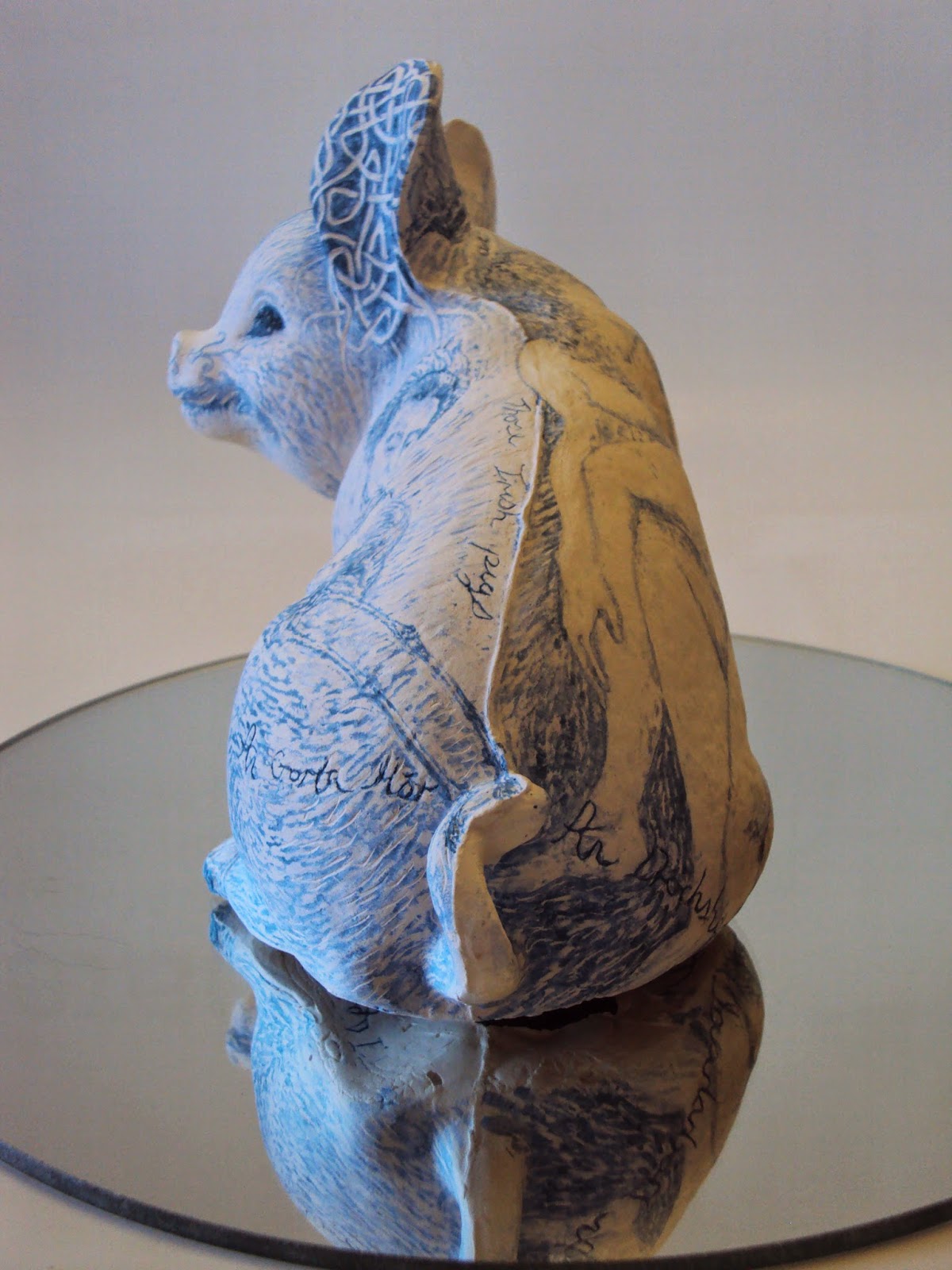
Irish pigs I

Ann-Marie Tully, Irish pigs I, ceramic, cobalt oxide, mirror, glass. 280mm x 300mm.

Ann-Marie Tully, Irish pigs I, ceramic, cobalt oxide, mirror, glass. 280mm x 300mm.

Ann-Marie Tully, Irish pigs I, ceramic, cobalt oxide, mirror, glass. 280mm x 300mm.

Ann-Marie Tully, Irish pigs I, ceramic, cobalt oxide, mirror, glass. 280mm x 300mm.

Ann-Marie Tully, Irish pigs I, ceramic, cobalt oxide, mirror, glass. 280mm x 300mm.

Ann-Marie Tully, Irish pigs I, ceramic, cobalt oxide, mirror, glass. 280mm x 300mm.

Ann-Marie Tully, Irish pigs I, ceramic, cobalt oxide, mirror, glass. 280mm x 300mm.

Ann-Marie Tully, Irish pigs I, ceramic, cobalt oxide, mirror, glass.
280mm x 300mm.


Ann-Marie Tully, Irish pigs I, ceramic, cobalt oxide, mirror, glass. 280mm x 300mm.

Ann-Marie Tully, Irish pigs I, ceramic, cobalt oxide, mirror, glass.
280mm x 300mm.

Ann-Marie Tully, Irish pigs I, ceramic, cobalt oxide, mirror, glass. 280mm x 300mm.

Ann-Marie Tully, Irish pigs I, ceramic, cobalt oxide, mirror, glass.
280mm x 300mm.


Ann-Marie Tully, Irish pigs I, ceramic, cobalt oxide, mirror, glass. 280mm x 300mm.


The Irish pigs series (2014) of cobalt oxide-painted ceramic pig sculptures reflects on the obscuration of animal beings in human visual culture. The choice of pigs as an ‘animal-ground’ to paint onto is informed by human indifference and repulsion towards these farmed animals – a position that allows for the conscience-free consumption of pork. The prevalence of pigs in art historical iconography is also a point of departure. The ceramic pig that the works are based on is an ornamental piece striking in its ‘benevolent’ anthropomorphic characteristics. This domestication of the animal is a phenomenon associated with decorative and illustrative representations of animals, serving to obscure the real creature. The slip-casting seams of the ceramic sculpture are not removed from the sculptural form, thereby interrupting a ‘smooth’ transition from the animal-in-the-world into the realm of human consumption. The decorative cobalt oxide painting on the frog-surfaces references the Willow, Oriental and Delft ceramic traditions that frequently employ nature motifs.

Thematically these works reference the assassination of Lord Mountbatten by the Irish Republican Army, after which Princess Anne was overheard saying ‘those Irish pigs’. This scorn for and reduction of the Irish ‘to the level of pigs’ is a long-standing European tradition. The works also reference the Kennedy dynasty – the tragic Irish ‘Camelot’. Artworks by artists of Irish origin such as James Abbott McNeill Whistler are referenced; as well as artworks by artists who courted controversy and were scorned and maligned (such as Jean Désiré Gustave Courbet and Amedeo Clemente Modigliani); also referencing artists who have used pig bodies and iconography in their artwork such as Wim Delvoye. Sources relating to the potato famines and the mass Irish immigrations that followed are juxtaposed with images drawn from photographs of my Irish immigrant families (Tully and McCarthy) who came to South Africa. The South African experiences and liminal identities of these Irish ancestors is considered in these works, which also allude to the colonial legacy in Africa that reduced human beings ‘to the level of animals’ – posing the rhetorical question: could the reduction of otherness exist without the category of the animal.