Welcome


Tuesday, 9 October 2012

Dog-Eat-Dog Paintings

Ann-Marie Tully. Dog—Eat—Dog: The Bleek house (Lucy 
Lloyd)2013. Oil on canvas. 300mm x 150mm. (Sold)


Ann-Marie Tully. Dog—Eat—Dog: The Bleek house (Lucy 
Lloyd), 2013. Oil on canvas. 300mm x 150mm. (Sold)


Ann-Marie Tully. Dog—Eat—Dog: The Bleek house 
(Wilhelm Bleek), 2013. Oil on canvas. 300mm x 150 mm. 
(Sold).


Ann-Marie Tully. Dog—Eat—Dog: The Bleek house 
(Dia!kwain and the jackel-man), 2013. Oil on canvas
400mm x 200mm. Framed. (Sold).

Ann-Marie Tully. Dog—Eat—Dog: The Bleek house 
(Dia!kwain and the jackel-man), 2013. Oil on canvas
400mm x 200mm. (Sold).


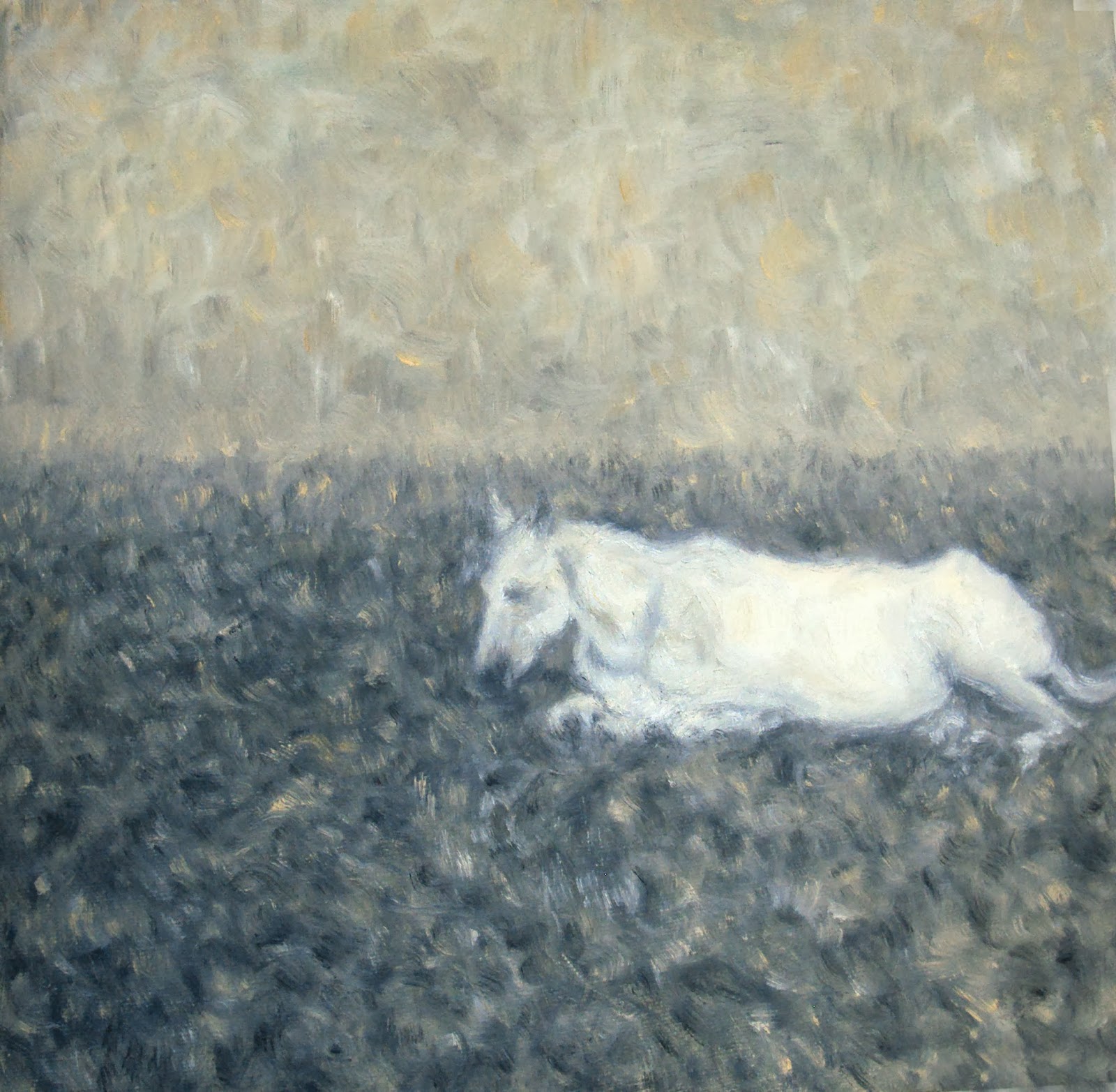
Ann-Marie Tully. Dog—Eat—Dog: Arctic Fox, 2013. Oil on canvas
300mm 300mm. Framed.
Ann-Marie Tully. Dog—Eat—Dog: Arctic fox, 2013. Oil on canvas
300mm 300mm.

Ann-Marie Tully. Dog—Eat—Dog: Fleeing fauns (Bilbao) - After 
Velasquez2013. Oil on canvas. 200mm diameter. Framed.


Ann-Marie Tully. Dog—Eat—Dog: POW songbird, 2013. 
Oil on canvas. 450mm 330mm. Framed.


Ann-Marie Tully. Dog—Eat—Dog: POW songbird, 2013. 
Oil on canvas. 450mm 330 mm.


Ann-Marie Tully. Dog—Eat—Dog: Korean song bird, 2013. 
Oil on glass (2 sided). 330mm x 270mm. (Sold).


Ann-Marie Tully. Dog—Eat—Dog: 
Underdog | Schiele's War, 2013. Oil on 
board. 430mm x 150mm.


Ann-Marie Tully. Dog—Eat—Dog: 
Underdog | Schiele's War, 2013. 
Oil on board. 430mm x 150mm.


Ann-Marie Tully. Dog—Eat—Dog: Highveld winter of 1901, 2013. Oil on 
canvas. 300mm 300mm. Framed.


Ann-Marie Tully. Dog—Eat—Dog: Highveld winter of 1901, 2013. Oil on 
canvas. 300mm 300mm.


Ann-Marie Tully. Dog—Eat—Dog: The regiment's unicorn, 2013. Oil on 
canvas. 300mm 300mm. Framed. (Sold).


Ann-Marie Tully. Dog—Eat—Dog: The regiment's unicorn, 2013. Oil on 
canvas. 300mm 300 mm. (Sold).


Ann-Marie Tully, Dog—Eat—Dog: Nabis Gas 
Mask, 2013. Gesso and oil on Fabriano. 300mm 
x 150mm. (Sold).
Ann-Marie Tully. Dog—Eat—Dog: Gas Mask I, 2013. 
Gesso and oil on Fabriano. 250mm x 210mm. 
Ann-Marie Tully. Dog—Eat—Dog: Gas Mask II, 2013Gesso and oil on Fabriano. 
300mm x 210mm.
Ann-Marie Tully. Dog—Eat—Dog: Gas Mask III, 2013Gesso and 
oil on Fabriano. 300mm x 190mm. 
Ann-Marie Tully. Dog—Eat—Dog: 3 Star General, 2013Gesso and oil 
on Fabriano. (Sold).

Ann-Marie Tully. Dog—Eat—Dog: Centaur Patrol, 2012Gesso and oil on 
Fabriano. 120mm x 195mm. 


Ann-Marie Tully. Dog—Eat—Dog: Great Coat Wolf, 2012
Gesso and oil on Fabriano. 130mm x 110mm
 

Ann-Marie Tully, Dog—Eat—Dog: Centaur Scout, 2012. Gesso 
and oil on Fabriano. 130mm x 110mm.


Ann-Marie Tully, Dog—Eat—Dog: Centaur Patrol, 2012.Gesso and oil on 
Fabriano. 120mm x 195mm.


Ann-Marie Tully, Dog—Eat—Dog: Centaur Scout, 2012Gesso 
and oil on Fabriano. 130mm x 110mm

Ann-Marie Tully, Dog—Eat—Dog: De Wet’s Men, 
2012Gesso and oil on Fabriano. 410mm x 285mm.

Ann-Marie Tully, Dog—Eat—Dog: Army of the 
Potomac, 2012. Gesso and oil on Fabriano. 600mm 
x 250mm.


Ann-Marie Tully, Dog—Eat—Dog: Boer Women
2010Gesso and oil on Fabriano. 
300mm x 210mm.


Ann-Marie Tully, Dog—Eat—Dog: Soldier, 2010. Gesso 
and oil on Fabriano. 300mm x 150mm. (Sold).


Chionomania [snow mania]

Ann-Marie Tully, Chionomania: snow fox, 2012. Oil on canvas. 17cm x 35cm.


Ann-Marie Tully, Chionomania: snow fox, (detail) 2012. Oil on canvas.
17cm x 35cm.


Ann-Marie Tully, Chionomania: lavander stag (detail), 2012. Oil on canvas.
18cm x 12cm.
 
 
Ann-Marie Tully, Chionomania: Polar Bear, 2012. Oil on canvas. 18cm x
12cm.


Friday, 5 October 2012

Blue Screen [Phase] Paintings...


     Blue Screen: The Wizard of OZ, 2012. Oil on canvas. 
Blue Screen: The Wizard of OZ (detail), 2012. Oil on canvas. 

Blue Screen: The Wizard of OZ (detail), 2012. Oil on canvas. 
Blue Screen: Bond (Moore), 2012. Oil on canvas.
Blue Screen: Bond (Lazenby), 2012. Oil on canvas. 
Blue Screen: Bond (Connery), 2012. Oil on canvas.
Blue Screen: Cold Mountain (Aida Monroe)2012. Oil on board150mm 150 mm. Framed.


Monday, 1 October 2012

Facing the Climate @ Michaelis Galleries/GIPCA Hot Water


Imagining Climate Change at Hot Water

September 2012

Facing the Climate, curated by Ann-Marie Tully in association with the Swedish Embassy of South Africa and the Swedish Institute is an environmentally-focussed exhibition that featured as part of The Gordon Institute of Performing and Creative Arts’ (GIPCA) Hot Water symposium on climate change, which took place at UCT’s Hiddingh Campus 28-29 September 2012.
 
The Facing the Climate exhibition series combines climate-themed cartoons by five Swedish artists, with the climate-related artworks of artists in host countries: in this case five South African cartoonists join five Swedish cartoonists in taking a sharp look at the climate issue, with the aim of encouraging discussion about the sustainable society and heightening awareness of current environmental problems. Facing the Climate has been staged in a number of international contexts, with exhibitions taking place during 2012 in Rio, Athens, Tirana, Tel Aviv and Novosibirsk amongst other cities around the world. The Facing the Climate exhibition in South Africa is curated by Ann-Marie Tully in association with the Swedish Embassy of South Africa.

Facing the Climate is part of a concerted drive, conceptualised by the Swedish Institute, to promote critical sustainable development under the heading ‘Facing the Future – Sustainability the Swedish Way’. The impetus behind this began in December 2009 in relation to the Copenhagen Climate Conference, when a group of 25 Nordic newspaper cartoonists provided some amusing and alarming reflections on climate change. To illustrate Sweden’s active involvement in this area, the Swedish Institute developed the digital climate exhibition Facing the Climate in collaboration with the Swedish cartoonists/illustrators Magnus Bard, Helena Lindholm and Riber Hansson. For this exhibition, they are joined by Love Antell and Karin Sunvisson in commenting on the global climate dilemma. The South African cartoonists/illustrators involved in this project are Tony Grogan, Wilson Mgobhozi, Ree Treweek, Sifiso Yalo and Zapiro.
 
Facing the Climate opened its run at Michaelis Galleries on 28 September 2012 as part of the GIPCA Hot Water Symposium, before travelling to NIROXprojects in Johannesburg for exhibition from 28 October 19 November, culminating in a final exhibition at the Oliewenhuis Museum in Bloemfontein from 11 April 9 June 2013.

For more information:


Monday, 30 July 2012

Bracha L. Ettinger's 'Lichtenberg Flower and Medusa', at Nirox Projects. Curated by Leora Faber and Ann-Marie Tully.


LICHTENBURG FLOWER AND MEDUSA
A solo exhibition by Artist Professor Bracha Lichtenberg Ettinger
NIROXprojects Gallery, Arts on Main, Maboneng Precinct,
249 Fox Street cnr Main road, Johannesburg.
13-29 August 2012
 
 
The exhibition opens 13 August at 18h30, with a presentation by Professor Ettinger at 19h00pm on her artworks. The exhibition runs till 29 August 2012. Lichtenberg Flower and Medusa is curated by Leora Farber and Ann-Marie Tully.


This exhibition accompanies the colloquium, Pointure: Pointing, Puncturing, Weaving and Lacing in Art Practice and Textual Discourse, convened by the Research Centre, Visual Identities in Art and Design, Faculty of Art, Design and Architecture, University of Johannesburg. The colloquium takes place on 15 August 2012 at the School of Tourism and Hospitality, University of Johannesburg, where Prof. Ettinger will present a keynote address. The colloquium and exhibition of Professor Ettinger’s artwork is accompanied by the exhibition entitled Pointure at the University of Johannesburg Gallery, curated by Ann-Marie Tully and Jennifer Kopping (8-29 August). 

 
Bracha Lichtenberg Ettinger is a prominent Israeli/French/British visual artist who divides her time between Paris and Tel Aviv. She holds the Marcel Duchamp Chair and is a Professor of Psychoanalysis and Art at the European Graduate School, Saas-Fee. Ettinger is also a senior clinical psychologist, a practicing psychoanalyst, and a theoretician working at the juncture between feminine sexuality, psychoanalysis, and aesthetics. Her enmeshed theoretical and artistic practice has made a significant impact in the fields of art, film, and literary studies, as well as psychoanalysis, queer, and gender studies. In her 'matrixial' theory and language, Ettinger extends upon the work of contemporary philosophers and psychoanalysts such as Emmanuel Levinas, Jean-Francois Lyotard, Gilles Deleuze, Félix Guattari and Jacques Lacan; and, although she is associated with contemporary French psychoanalytical feminism, in her work, she challenges Julia Kristeva’s and Luce Irigaray’s abject formulation of the feminine, rearticulating this maligned genus as a model for thought and discourse. As artist/psychoanalyst and artist/philosopher, Ettinger is an author of numerous articles and books on psychoanalysis, aesthetics and ethics, including the seminal volume The matrixial borderspace (collected essays from 1994 to 1999 with introductions by Judith Butler, Griselda Pollock and Brian Massumi, University of Minnesota Press, 2006).

 
Her art practice reflects an engagement with the articulation of the ‘proto-ethical’ potential of art, her re-thinking of subjectivity and feminine difference, artworking and art's object, beauty and sublimity. Ettinger’s art practice is primarily as a painter, working in an interdisciplinary manner that incorporates oil-painting, drawing, photography, poetic notebooks, writing-drawing, conversation, lecturing-performances and encounter-events. Her figural-abstract paintings, artist’s notebooks and other artistic works have had a significant influence on global contemporary art, art criticism and art history over the past decade. Two books dedicated to her artwork, namely Art as compassion. Bracha L. Ettinger (eds. Catherine de Zegher & Griselda Pollock) and Le cabinet de Bracha (ed. Patrick le Nouene) were published in 2011.

 
Ettinger has held solo exhibitions at MoMA, Oxford (1993); Israel Museum, Jerusalem (1995); Palais des Beaux-arts, Brussels (2000); the Drawing Center, New York (2001); the Freud Museum, London (2009); the Musée des Fundació Antoni Tàpies, Barcelona (2010); Beaux-Arts d'Angers (2011) and Casco, Utrecht (2012). Recent performance/installation and lecturing ‘encounter-events’ have taken place at the ICI, Berlin (2010), Poznańskie Towarzystwo Przykaciół Nauk, Poznań (2011) and the Arts Nova Museum, Turku (2011). She has participated in major international group exhibitions including Feminine Presence (Tel Aviv Museum, 1990); Face a L’Histoire (Centre Pompidou, Paris, 1996); Kabinet (Stedelijk Museum, Amsterdam, 1997); Inside the Visible (ICA, Boston, Whitechapel, London and Art Gallery of Western Australia, Perth, 1996-1997); Aletheia (Konstmuseum, Göteborg, 2003); ARS 06 Biennale (KIASMA, Helsinki, 2006) and Gorge(1) (The Royal Museum of Fine Arts, Antwerp, 2006-2007).
This exhibition provides a fascinating insight into Ettinger’s pioneering and composite practice, through a selection of artworks in diverse media, ranging from drawings produced from 1987 to 1981; paintings dating from 2004 to 2009; a recent range of drawings (2010-2012) and a series of artist’s notebooks produced during the years 2003 to 2012. These artworks embody a porous and rich terrain of aesthetic and theoretical devices: notions of trace and inscription in the face of digital anonymity; the interplay of mechanisation and mark (“reprographic” means), staged alongside the iconography of ghostly and traumatic apparitions “becoming” effaced and palempsestual; the detritus of the unconscious, the prosaic, the unsightly and the unvalourised subject; the notebook as an intersection between the analyst/artist and the residual dialogue with an[Other]; the employment of the photographic image/object as a ground that is diluted through process to that of a fading spectre; a sense of disembodied relational aesthetics where classical distance and intimacy implode.[1] Ettinger’s luminous paintings mine the physics of light and colour, a liminal terrain where the insubstantial force becomes a rendered and allegorical gesture.[2]
A recent essay by Nicolas Bourriaud reflecting on Ettinger’s oeuvre entitled, Bracha Ettinger: figures of out-off (Hors) (2012) will be available at the exhibition.


[1] Collated with reference to Bourriaud, N. 2012. Bracha Ettinger: figures of out-off (Hors). Translated by Tali Bogen. Editing of the translation by Joseph Mulligan. Paris: Unpublished.


[2] Manning, E. 2010. Vertiginous Before the Light. The Form of Force. In Art as Compassion: Bracha L. Ettinger, Catherine De Zegher and Griselda Pollock (eds). Brussels: ASP (Academic & Scientific Publishers): 173-189.